Trustworthy Data First: Permission and Interpretation Boundaries on a Behavior-Data Chain
Why AI should get a controlled, auditable data outlet instead of a database account, and where its interpretive authority has to stop.
When a team asks AI to analyze user behavior, the easy mistake is putting AI where it does not belong. Hand a read-only database account to an analysis tool and it will write its own SQL, fetch its own data, and reach its own conclusion. That collapses three responsibilities into one: who defines the data, who interprets it, and who is accountable for the conclusion.
Reporting here was a daily routine, shared with the team and with leadership. Reviewing AI-written SQL by hand every morning was not sustainable, and having several AIs check each other is only self-deception. A statement that corrupts data or stops a service is not reversible, and backups on modest infrastructure are not a reason to keep taking the risk. So I drew the line: AI can obtain data, but never connects to the database. The system owns collection, aggregation, definitions, and permissions; AI only explains data that has passed through a masked, auditable outlet.
Trust before access
The tracking system looked simple: emit an event, write a row. Collection turned out to be the starting point, not the achievement. A crashed job left a window of events unaggregated; an exclusion list entered per single user dimension failed the whole batch; an aggregation lock was taken and never released, freezing a refresh button for over ten minutes; malformed messages were never acknowledged and were re-read every two seconds until one log line filled hundreds of megabytes; dwell time had no cap, so backgrounded tabs inflated averages by an order of magnitude.
None of these were elegance problems. All were trust problems. My test became: does this metric reveal itself when it breaks? Only then is it worth letting AI analyze.
One definition, many outlets
The page said 100, the export said 98, the AI answered 103. Nobody had lied; four pieces of code had drifted apart. We collapsed them into one retrieval definition with several rendering outlets: page, export, report, and AI endpoint share the same aggregate result and differ only in presentation. A new outlet adds a rendering layer, not another calculation.
This is first a matter of credibility. The feature exists so the team can do data analysis; if the channels disagree, the system has none. It also means the sharing boundary is written once. Aggregate or raw detail, which fields are masked, which internal events are excluded—one control standard, applied everywhere. The report can be trimmed for sharing, but its source numbers must be identical to every other outlet. Definitions have to be written down as well; rules that live in someone’s head get reinvented by AI with a new assumption every time.
A controlled door
The key trade-off sits here: AI needs data, not the database key.
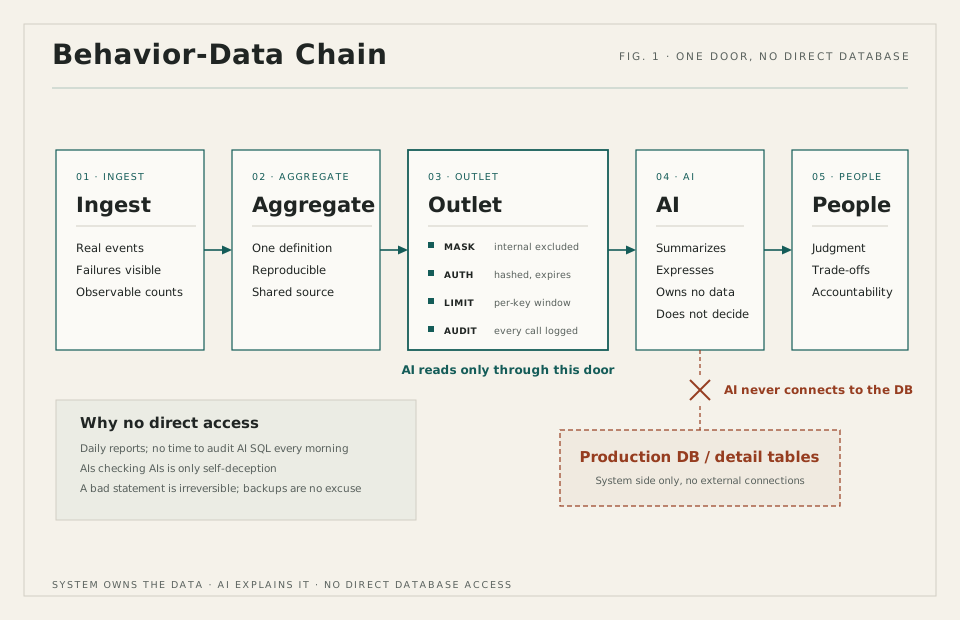
Fig. 1: The system owns collection, aggregation, definitions, and permissions. AI stands outside the outlet; "AI never connects to the database" is the baseline of this chain, not an implementation detail.
What I opened for the analysis side is an outlet, not a connection. Aggregates come first: raw detail has too many fields—mask heavily and the analysis is meaningless, mask lightly and a leak is serious. “Not identifiable” does not mean “safe to hand out.” Data is masked, with internal events excluded, identities coded, and aggregates carrying a no-differencing warning. Access needs a hashed key with an expiry, rate limits are per key, and every call is logged. The goal is not an all-powerful AI but one whose every fetch can be explained, refused, and traced to someone.
One detail is easy to miss: a human is still in the loop that generates and passes keys. We did encounter a caller rejected for using an old key. The audit showed no authentication bug—just human rotation and old and new text mixed up. The structural fault was the earlier design that killed the old key the moment a new one appeared. We moved to a truncation model: the new key lasts 24 hours, the old one keeps 30 minutes, shortened and never extended. Rather than reminding people to remember the rotation, the design absorbs an error that will certainly happen.
Silent failure has to surface
At another endpoint—not this chain—a colleague-maintained writer stopped silently for days. Writes failed on a mismatched default value while the endpoint kept returning HTTP 200. No alert fired; the data was simply gone. That was not a confirmed incident here, but it names the general risk: the worst form of collection failure is not an error, it is looking successful. So writes get observable counters, aggregation jobs get status and timeouts, bad messages get a retry ceiling and a dead-letter record, and reports distinguish “no data today” from “today’s data never arrived.”
Where AI’s authority ends
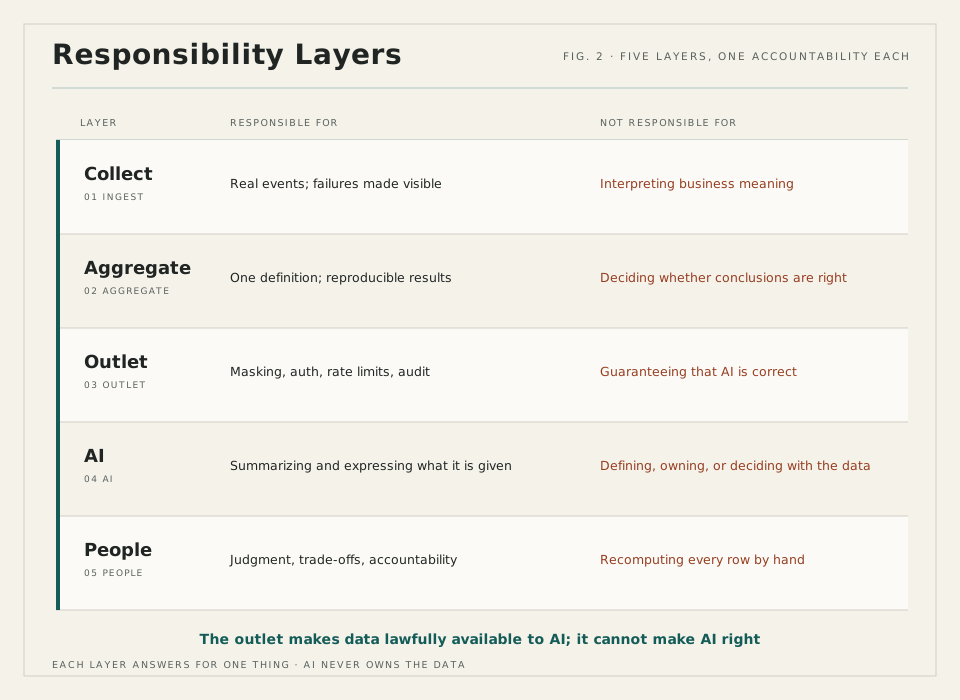
Fig. 2: Each layer answers for one thing. The outlet guarantees that AI can get data lawfully, not that AI is right; that remains a human judgment.
AI’s value in this structure is cost reduction, not doing what people cannot. Without AI we could still run the analysis, but every class of data would need its own structure, approach, and result format, and each new event would need another analysis logic. AI is good at reading information that is not well structured and at reusing that reading inside the local reporting workflow I keep iterating. The boundary is just as clear: I do not let AI improvise arithmetic, and what the data is for can only be decided by a person. To judge whether an analysis is trustworthy I recheck three things—the data source, the method, and the definition. The system guarantees the source and the definition; a person guards the method.
What this chain does not solve
Masking is a combination of exclusion, coding, and anti-differencing, not a field-level whitelist that can be advertised as complete. Definitions are continuous governance; every new event class needs dictionary entries and translations to follow. We verified that the daily report ties out against the manual version, but we did not measure how much faster AI writes it—reproducibility of repetitive work is not measured efficiency. And fixes on the collection side ship separately from client releases, so users on older versions may still contribute distorted data.
None of this weakens the core judgment; it confirms it. The value of behavior data does not depend on how smart the AI is. It depends on how trustworthy the chain is and how clear the permission boundary is.
In one line
Let AI explain the data. Do not let AI own it.