After AI Says “Done”: Contracts and Independent Verification for Real-World Delivery
How explicit task contracts, independent review, and fresh-eye reproduction turn “the AI says it’s done” into portable, checkable evidence.
When an AI system tells me that everything passes, I start asking a different set of questions: Who defined “done”? Who verified it? Could someone unfamiliar with the implementation reproduce the same conclusion?
Over several months, I used multi-agent workflows in real business delivery at a startup. They accelerated implementation, but also exposed a bottleneck: more generated output creates more work that must be verified. I learned that reliable delivery cannot depend on the producer’s own report.
The first step was to turn acceptance criteria into executable contracts before implementation. For one data task, I wrote the assertions in about 25 minutes. Against the old baseline, five checks failed for the intended reasons, while a guard check passed to protect unchanged behavior. This red-to-green evidence showed that the checks could distinguish the defect from the fix. The contract was then frozen rather than quietly adjusted to match the implementation.
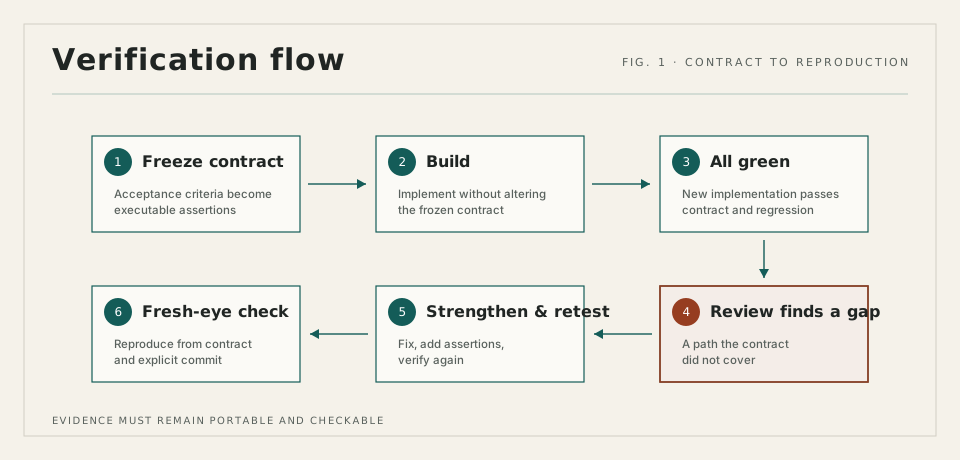
Fig. 1: A six-step verification loop, from a frozen contract to fresh-eye reproduction; orange marks the gap found outside the contract.
But green checks were not the end. Independent review later found a missing cap in a Java accumulator path that the original XML-focused checks did not cover. We reproduced the issue with extreme paired data, fixed the implementation, strengthened the contract, and verified it again. The lesson was specific: contracts make known requirements repeatable; independent review helps discover what the contract missed. They are complementary.
I then moved one step further. In a backend export verification task, I separated builder, reviewer, and new-eye evidence. A new reviewer received only an explicit commit and a frozen contract hash, and reproduced all 11 checks. The preview count also matched an independent SQL result. Verification became portable instead of depending on the original author’s explanation.
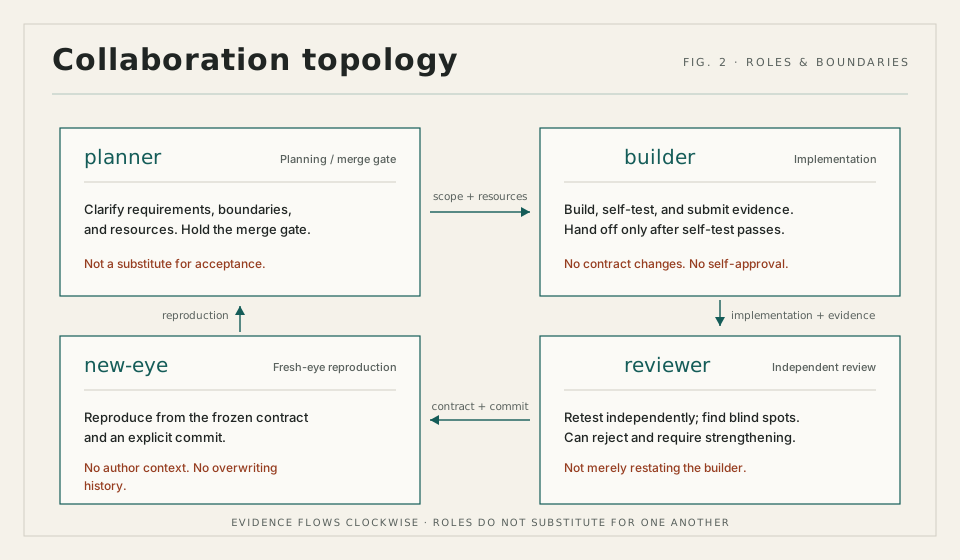
Fig. 2: Responsibilities, prohibitions, and evidence flows across planner, builder, reviewer, and new-eye.
This approach has real costs: contract design, environment setup, independent review, and evidence maintenance. I have not established a universal productivity claim, and green checks still cannot prove complete coverage.
For me, effective multi-agent delivery is not about adding more AI roles. It is about creating a system in which AI output can be proven wrong—and in which the person accountable for delivery can explain exactly why it is ready.
This is a summary; the full case study is in Chinese: read the Chinese version.